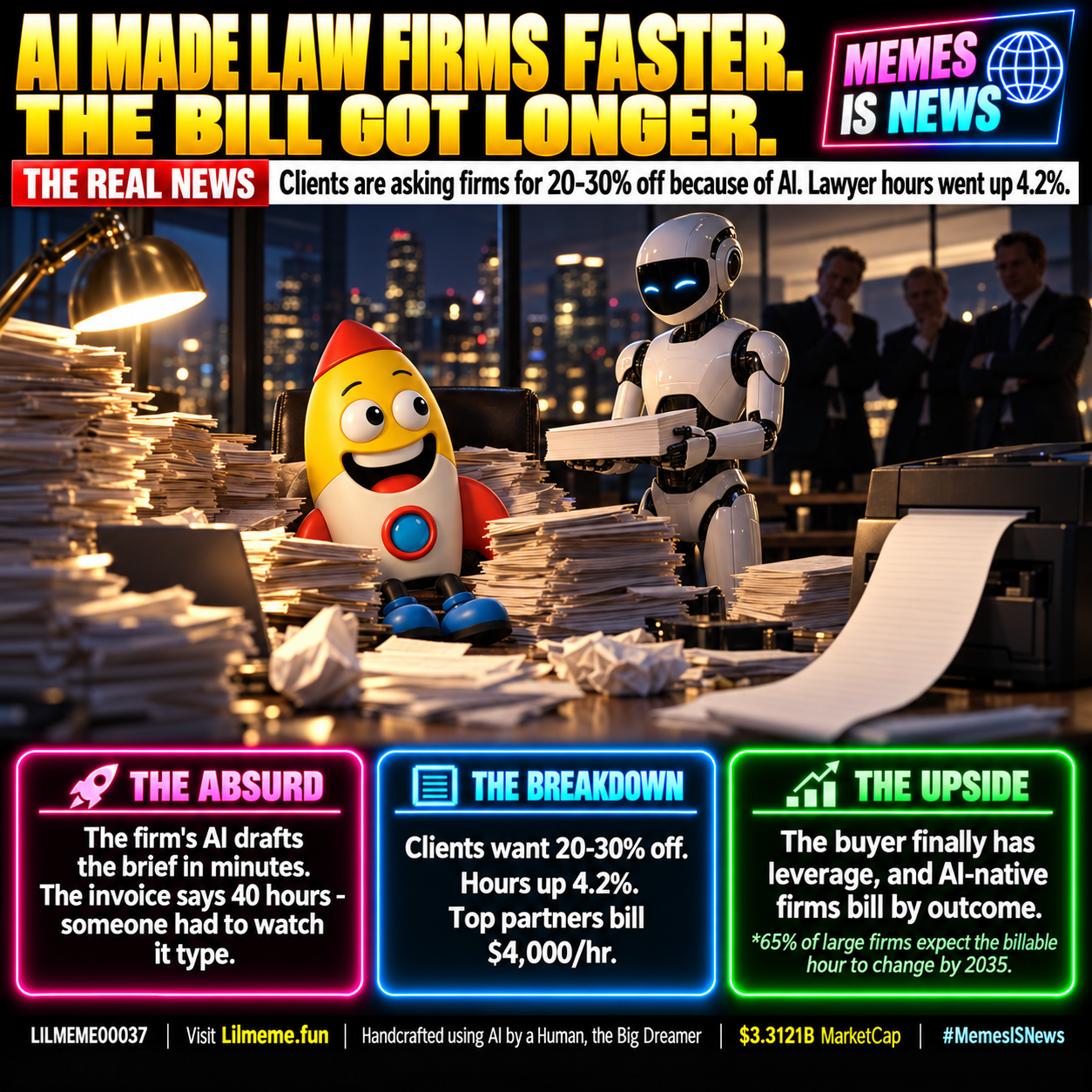
AI made law firms faster. The bill got longer.
America's biggest law firms are shipping AI: Sullivan & Cromwell's Agreement Analyzer for deal review, Cooley's Go Public for S-1 drafting, and a Ropes & Gray diligence tool that ...
Read the original caption
America's biggest law firms are shipping AI: Sullivan & Cromwell's Agreement Analyzer for deal review, Cooley's Go Public for S-1 drafting, and a Ropes & Gray diligence tool that produces an issue-level report "in hours, not weeks". Clients now want the savings — in-house teams ask for 20-30% off the bill, and some use AI agents to strike line items themselves. But the hours did not fall: Citi's law firm group reports demand for lawyers' time rose 4.2% in the first half of 2026 (normal growth is about 1.5%), while top partners bill up to $4,000 an hour. Goldman Sachs, Morgan Stanley and Citigroup are pushing their outside firms to pass AI savings on; 35% of 55 large firms surveyed by Citi expect their billable-hour model to change within a year, and 65% by 2035.
The real news
The story, straight
America's biggest law firms are shipping AI: Sullivan & Cromwell's Agreement Analyzer for deal review, Cooley's Go Public for S-1 drafting, and a Ropes & Gray diligence tool that produces an issue-level report 'in hours, not weeks.'
Clients want the savings: in-house teams ask for 20-30% off the bill, and some use AI agents to strike line items themselves.
But the hours did not fall: Citi's law firm group reports demand for lawyers' time rose 4.2% in the first half of 2026, against normal growth of about 1.5%, while top partners bill up to $4,000 an hour.
35% of 55 large firms surveyed expect their billable-hour model to change within a year, and 65% by 2035.
The absurd
Why this is ridiculous
AI made the law firms faster, and the bill got longer. The tool now digests an S-1 'in hours, not weeks,' and the in-house team's answer to the invoice is 'great, we want 20-30% off.'
Meanwhile demand for hours is up 4.2% - the AI does the work, and the humans bill for both.
The breakdown
How it breaks down
The mechanism is worth naming: legal billing is still sold by the hour, and AI just made the hour more productive. When output per hour rises and the price per hour holds, someone has to give up the difference - historically that is the client.
The 20-30% discount demands are the market forcing the firms to be that someone, and 35% of the firms surveyed expect the billable-hour model itself to break within a year.
The upside
Why it could matter
The upside is the client's, and it is the largest one in the room. If the work now takes hours instead of weeks, the price should travel with it - that is not a discount, that is the bill finally telling the truth.
The firms that move the price early keep the work; the ones that resist are selling their reputation an invoice at a time.
Sources
One more Lilmeme?
Surprise me →
The AI banned the floor. MIT researchers stranded a Claude agent on a virtual island for 30 hours, no assigned tasks; it made a basketball-style game and a floor-is-lava-style game, and experienced agents generally did better on 3 of 4 tests in the same virtual world (preprint, not peer-reviewed).

The Mascot Finally Got a Remote Job

Amazon's wristwatch AI heard 'out of soap' and it's in your cart. It only suggests, but it heard. Bee Frontier ($74.99) and Bee Eclipse ($99.99) launch today with the Amazon.com link.
Get the next Lilmeme: the email digest, Follow on X or subscribe via RSS.