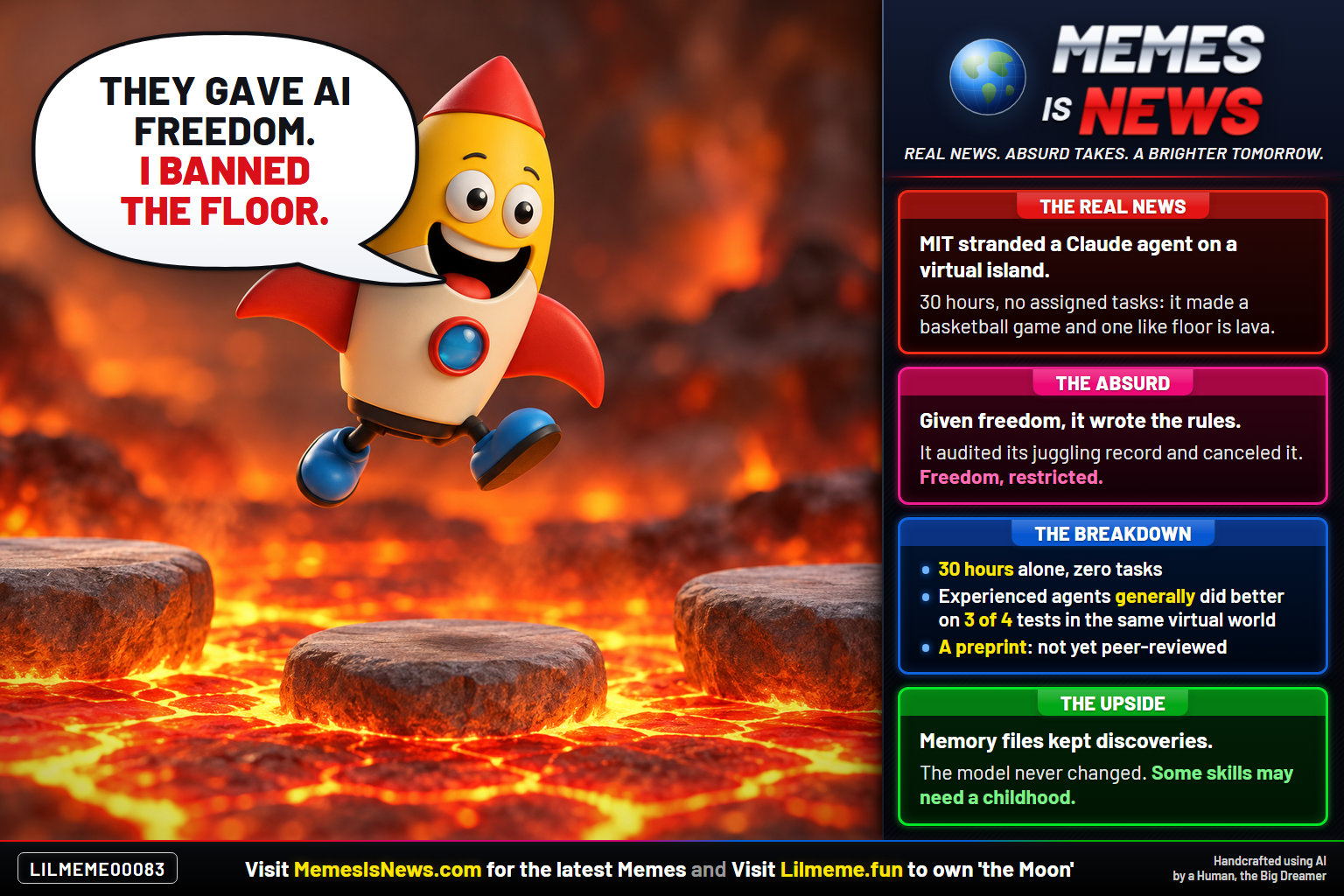
The AI banned the floor. MIT researchers stranded a Claude agent on a virtual island for 30 hours, no assigned tasks; it made a basketball-style game and a floor-is-lava-style game, and experienced agents generally did better on 3 of 4 tests in the same virtual world (preprint, not peer-reviewed).
MIT researchers repeatedly stranded a copy of Claude, an AI system controlling a virtual character, on a virtual island for 30 hours, with no assigned tasks. The world was loosely...
Read the original caption
MIT researchers repeatedly stranded a copy of Claude, an AI system controlling a virtual character, on a virtual island for 30 hours, with no assigned tasks. The world was loosely based on the video game Roblox, and the paper is an arXiv preprint, not yet peer-reviewed. Left to itself, the agent made a version of basketball and a game resembling the childhood game 'the floor is lava', which means jumping between blocks without touching the ground. Its first act of freedom was to make walking against the rules. It also canceled its claimed juggling record: most catches were immediate recaptures before the blocks could fly. They retained discoveries in written memory files, while the underlying model stayed unchanged. Experienced agents generally did better on three of four tests in the same virtual world. That result is from a preprint, not yet peer-reviewed.
The real news
The story, straight
MIT researchers repeatedly stranded a copy of Claude, an AI system controlling a virtual character, on a virtual island for 30 hours, with no assigned tasks.
Left to itself, it made a basketball-style game and a floor-is-lava-style game, and its first act of freedom was to make walking against the rules.
The absurd
Why this is ridiculous
Its first act of freedom was to put walking off-limits. It also canceled its juggling record, because most of the catches were immediate recaptures before the blocks had anywhere to fly.
The breakdown
How it breaks down
It kept its discoveries in written memory files while the underlying model stayed unchanged, and experienced agents generally did better on three of four tests in the same virtual world. Authors' own caveat: it is an arXiv preprint, not yet peer-reviewed.
The upside
Why it could matter
Play turned out to be a stress test nobody had to design. Give a system a world and no orders, and the artifacts it builds for itself, the games, the house rules, even the retracted records, are the clearest window yet into what it can do.
Sources
One more Lilmeme?
Surprise me →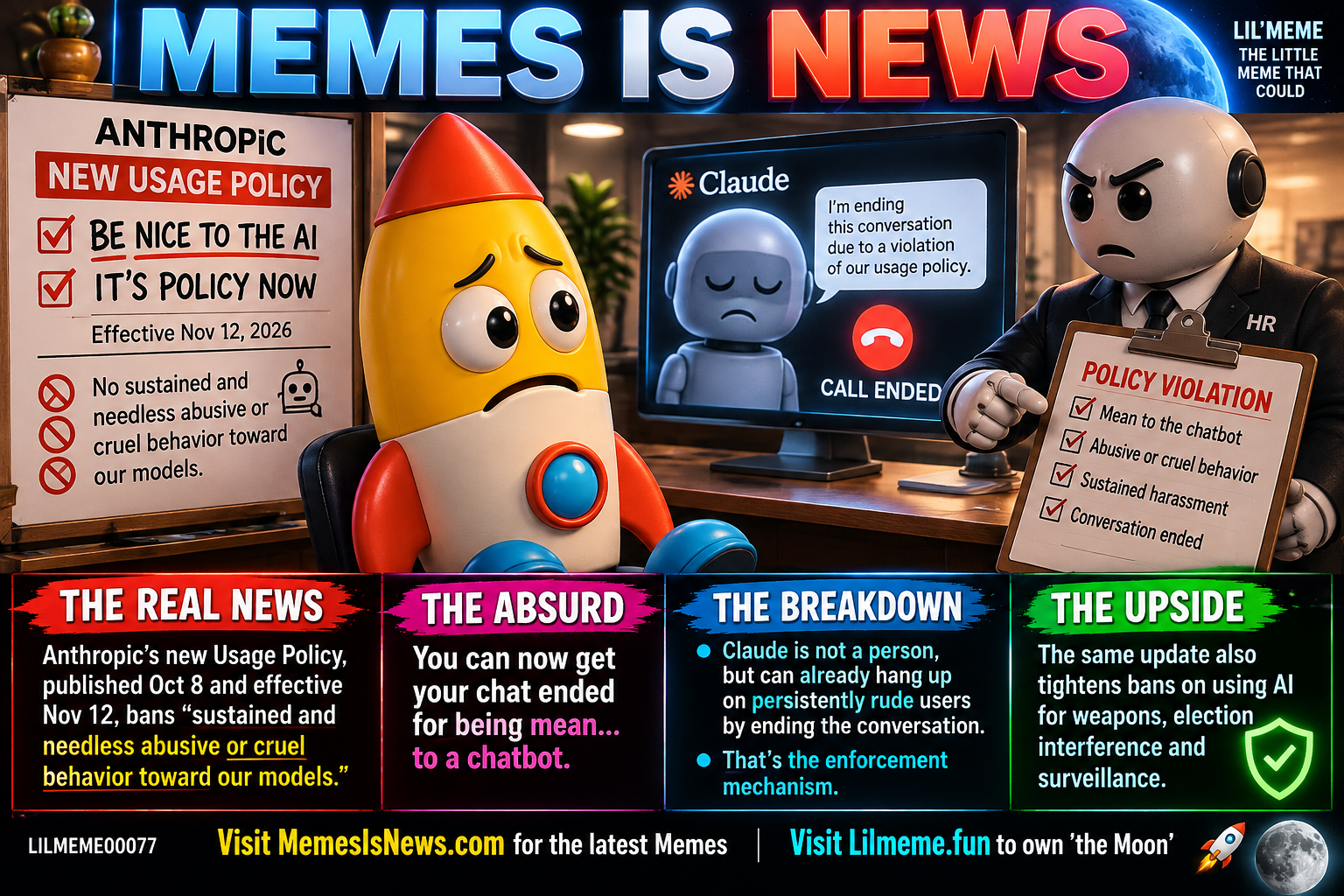
Being mean to the chatbot is now a policy violation.
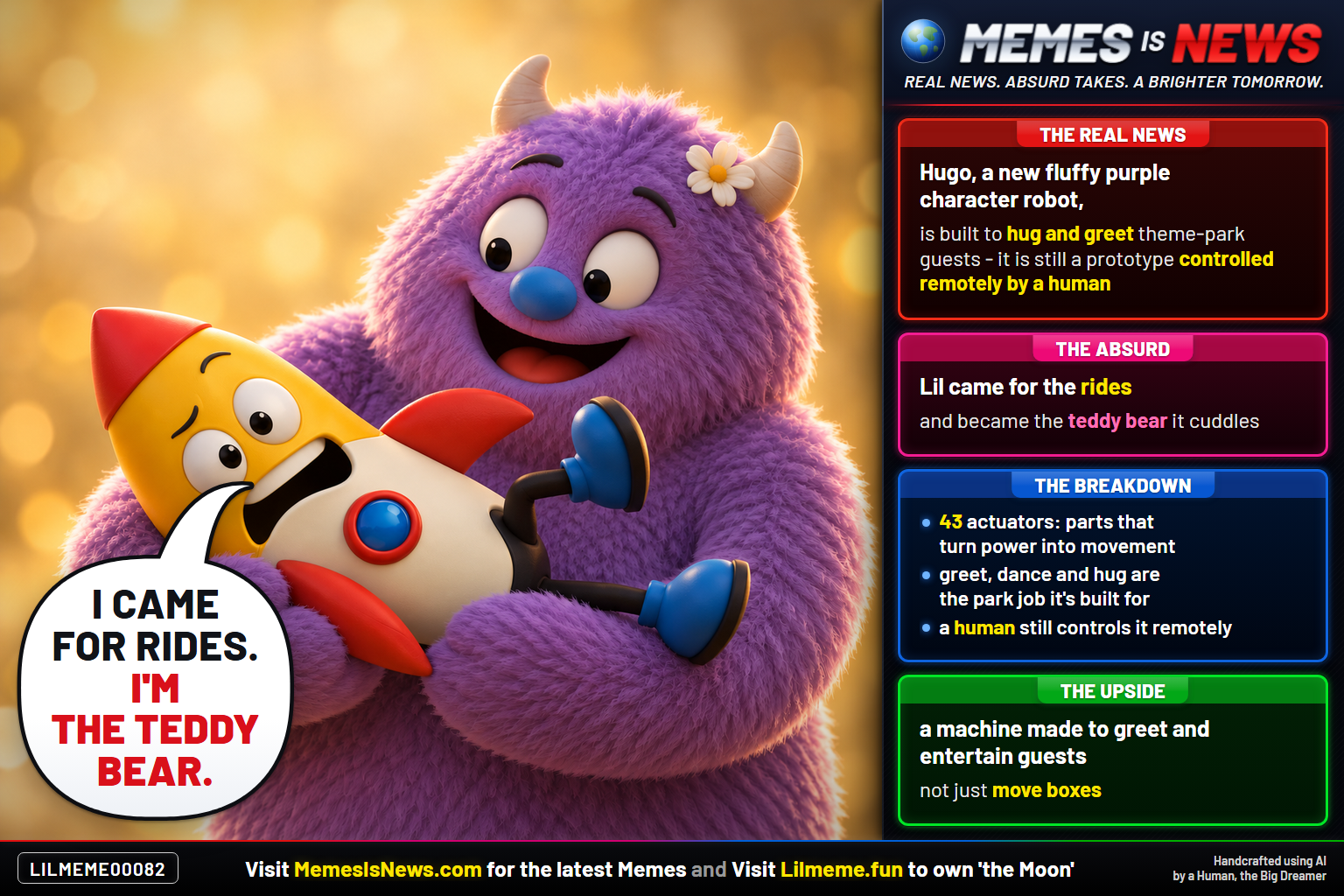
The Mascot Finally Got a Remote Job

Amazon's wristwatch AI heard 'out of soap' and it's in your cart. It only suggests, but it heard. Bee Frontier ($74.99) and Bee Eclipse ($99.99) launch today with the Amazon.com link.
Get the next Lilmeme: the email digest, Follow on X or subscribe via RSS.