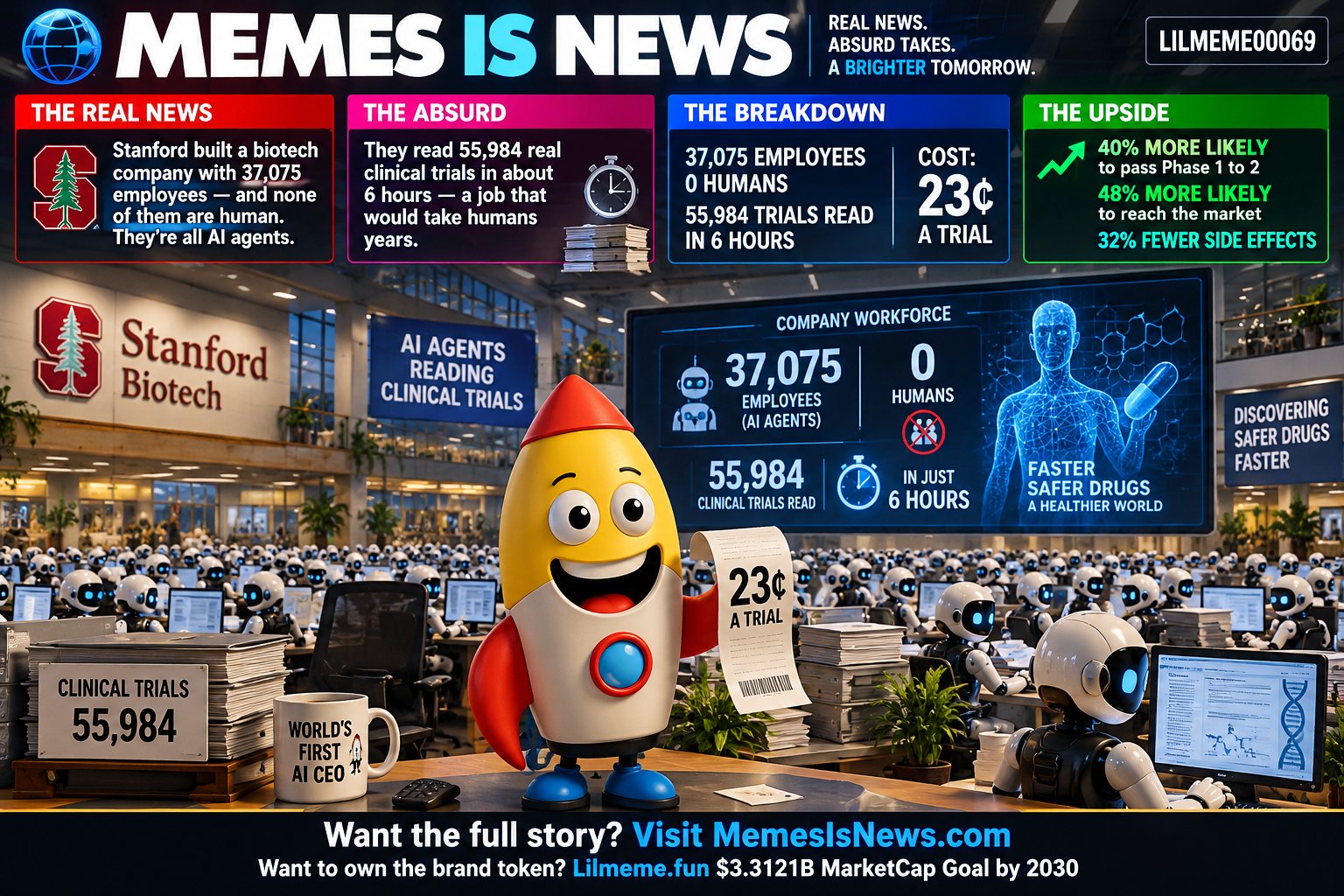
37,075 employees. Zero humans. 23 cents a trial.
A biotech run entirely by AI agents — 37,075 of them — read 55,984 real clinical trials in about six hours, a job that takes human teams years, for a median of 23 cents per trial....
Read the original caption
A biotech run entirely by AI agents — 37,075 of them — read 55,984 real clinical trials in about six hours, a job that takes human teams years, for a median of 23 cents per trial. The system, built in James Zou's lab in Stanford's Department of Biomedical Data Science and published in Science, found that drugs aimed at genes active in only a few kinds of cells were 40% more likely to pass Phase 1 to 2, 48% more likely to reach the market, and reported 32% fewer side effects. The caveat: it read trials that already happened, so it is a strong clue, not proof.
The real news
The story, straight
A biotech operation run entirely by AI agents - 37,075 of them - read 55,984 real clinical trials in about six hours, a job that takes human teams years, at a median 23 cents per trial. Built in James Zou's lab at Stanford's Department of Biomedical Data Science and published in Science.
The team found drugs aimed at genes active in only a few cell types were 40% more likely to pass Phase 1 to 2, 48% more likely to reach market, and 32% less likely to report side effects.
The absurd
Why this is ridiculous
37,075 employees. Zero humans.
23 cents a trial. The cheapest lab in the history of science has never once asked for a break, and it has already published in Science.
The breakdown
How it breaks down
The scale is the point: 56,000 trials in six hours is not 'faster,' it is a different labor category - reading became a cost line item. The finding that survives the headline is the narrow-targeting result: drugs aimed at genes active in a few cell types did better across the board.
Broad is a shotgun; narrow is a key. The AI just made the search for keys affordable.
The upside
Why it could matter
The honest caveat: it read trials that already happened - a strong clue, not proof. But the direction of travel is the lesson: in medicine, the scarcest input was never ideas, it was attention to what is already known.
That input may have just become the cheapest thing in the building.
Sources
One more Lilmeme?
Surprise me →
The AI banned the floor. MIT researchers stranded a Claude agent on a virtual island for 30 hours, no assigned tasks; it made a basketball-style game and a floor-is-lava-style game, and experienced agents generally did better on 3 of 4 tests in the same virtual world (preprint, not peer-reviewed).

The Mascot Finally Got a Remote Job

Amazon's wristwatch AI heard 'out of soap' and it's in your cart. It only suggests, but it heard. Bee Frontier ($74.99) and Bee Eclipse ($99.99) launch today with the Amazon.com link.
Get the next Lilmeme: the email digest, Follow on X or subscribe via RSS.