Psst. Want me to read this one to you?
Tap me or the button.
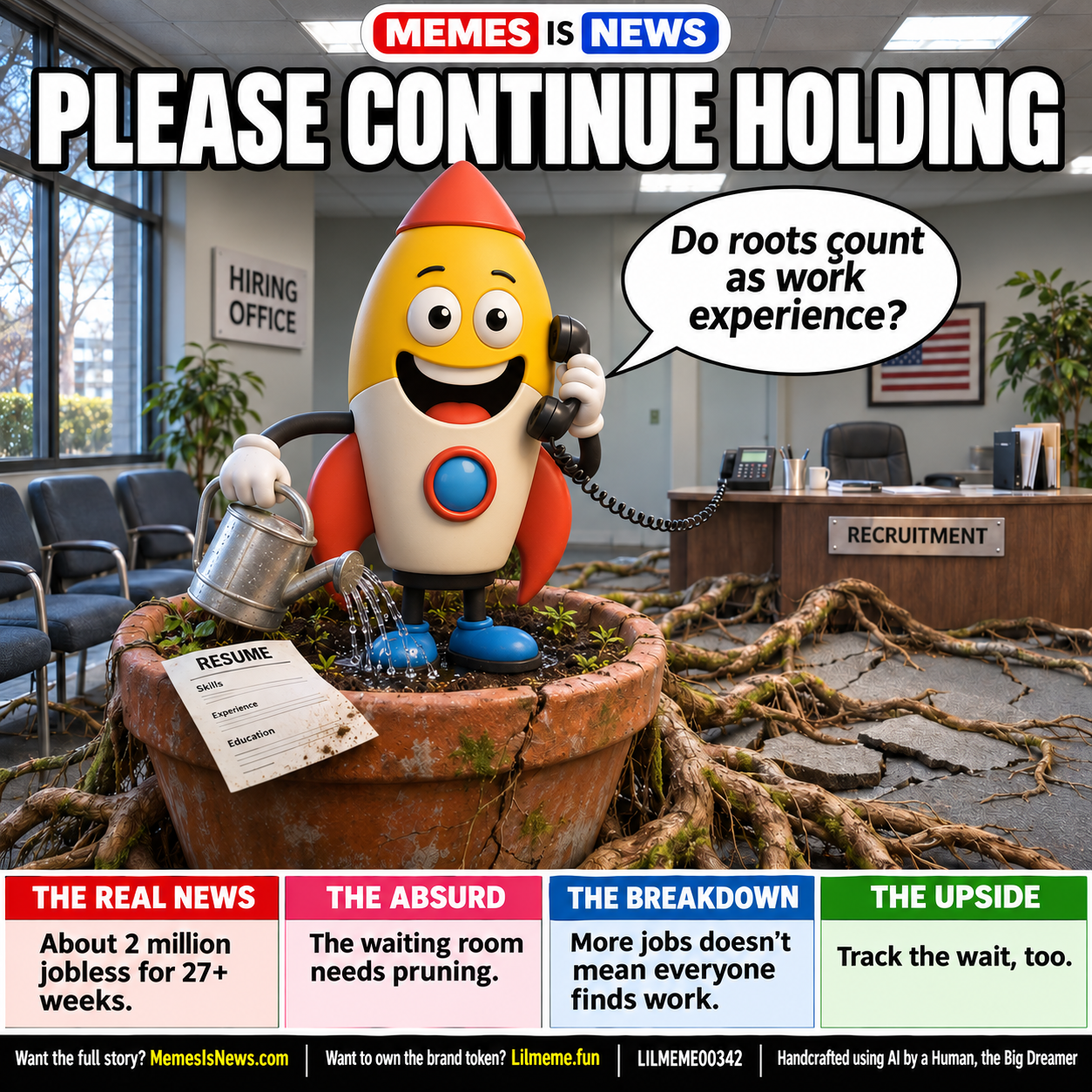
PLEASE CONTINUE HOLDING
A jobs report counts jobs, but it also asks people whether they have work. Those are different measurements: payroll growth measures the net change in jobs, while unemployment mea...
The real news
The story, straight
A jobs report counts jobs, but it also asks people whether they have work. Those are different measurements: payroll growth measures the net change in jobs, while unemployment measures people without work who are available and actively looking.
The U.S. Bureau of Labor Statistics reported 165,000 additional nonfarm payroll jobs in October 2026. The unemployment rate was 4.1%, with 7.1 million people unemployed.
Meanwhile, 1.963 million people had been jobless for 27 weeks or more, rounded by BLS to 2.0 million. They represented 27.6% of unemployed people.
So, in our imaginary hiring lobby, Lil'meme has planted himself in a flowerpot while holding the phone. If the system won't give him a position, perhaps it will give him photosynthesis.
BLS Table A-12 puts the mean unemployment duration at 27.1 weeks, up from 24.8 in September. The mean adds everyone's unemployment durations and divides by the number of people.
Long spells pull it upward. The median, the middle duration when people are ordered by their waits, was 11.9 weeks.
These figures don't establish what caused the waits. They do show why job gains alone cannot describe everyone's experience.
The useful takeaway: watch how long people remain unemployed alongside how many jobs employers add. Confetti is not a hiring strategy.
Source: BLS, October 2026 Employment Situation, released 6 November 2026.
Repost before the waiting room gets reclassified as a forest.
Thanks for supporting Lil'meme. Your support is appreciated.
The absurd
Why this is ridiculous
The waiting room needs pruning.
The breakdown
How it breaks down
More jobs doesn't mean everyone finds work.
The upside
Why it could matter
Track the wait, too.
Sources
One more Lilmeme?
Surprise me →


Get the next Lilmeme: the email digest, Follow on X or subscribe via RSS.