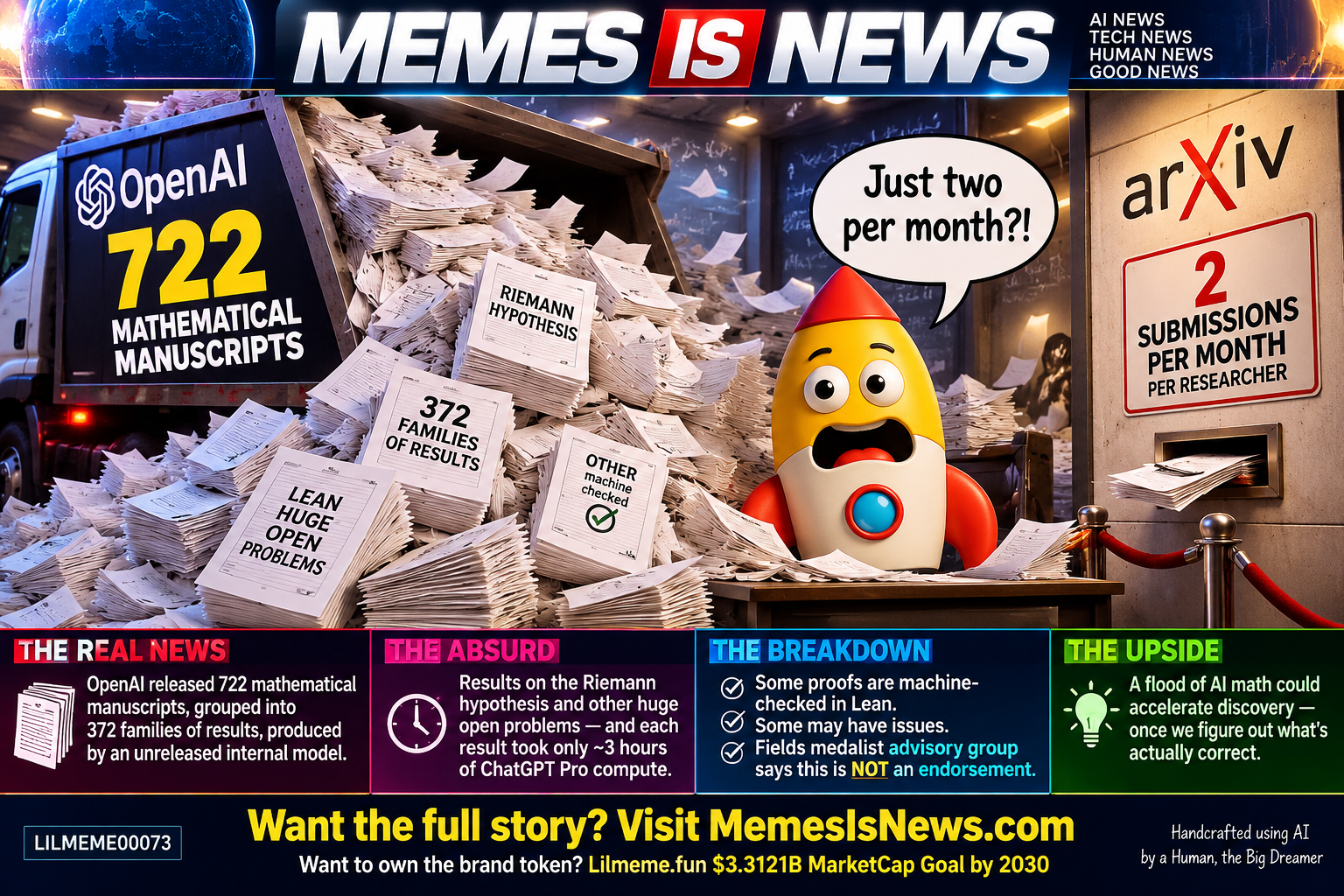
OpenAI dumped 722 math papers. The slot takes 2 a month.
OpenAI published 722 mathematical manuscripts, grouped into 372 families of results, on GitHub, all produced by an unreleased internal model it has not named or released. The coll...
Read the original caption
OpenAI published 722 mathematical manuscripts, grouped into 372 families of results, on GitHub, all produced by an unreleased internal model it has not named or released. The collection covers the Riemann hypothesis and other long-open problems; the average result took roughly three hours of ChatGPT Pro thinking compute. Many proofs are machine-checked in Lean, but some may have issues, and the advisory group of Fields medalists says the release is not an endorsement. The same week, preprint server arXiv capped every researcher at two submissions a month to stem the flood of AI papers.
The real news
The story, straight
OpenAI published 722 mathematical manuscripts, grouped into 372 families of results, on GitHub. They were produced by an unreleased internal model OpenAI has not named or released.
The collection covers long-open problems including the Riemann hypothesis; most proofs are machine-checked in Lean, and the advisory group of Fields medalists says the release is not an endorsement.
The same week, arXiv capped every researcher at two submissions a month to stem the flood of AI papers.
The absurd
Why this is ridiculous
OpenAI dropped 722 math papers in a single batch. The same week, the world's biggest preprint server said: two a month, please.
It is one kid handing in a stack of homework taller than the desk, and the school capping everyone else at one assignment per week.
The breakdown
How it breaks down
The part that should change your mind is 'machine-checked': Lean is a proof assistant that verifies each step, so 'the AI did it' now comes with a referee. But the referee is young, and the Fields medalists explicitly say this is not an endorsement.
The real capacity problem: when output scales to 722 manuscripts a week, review cannot. The bottleneck just moved from doing the math to trusting it.
The upside
Why it could matter
The upside is the backlog. Problems that sat open for a century now have drafts, and the drafts have checkers.
Math is the first field where an AI can be a genuine co-worker instead of an autocomplete - if the review side ever catches up to the drafting side, and arXiv's cap is someone's first honest attempt to make that happen.
Sources
One more Lilmeme?
Surprise me →
Swap 1 word in 10 and the AI watermark's gone.
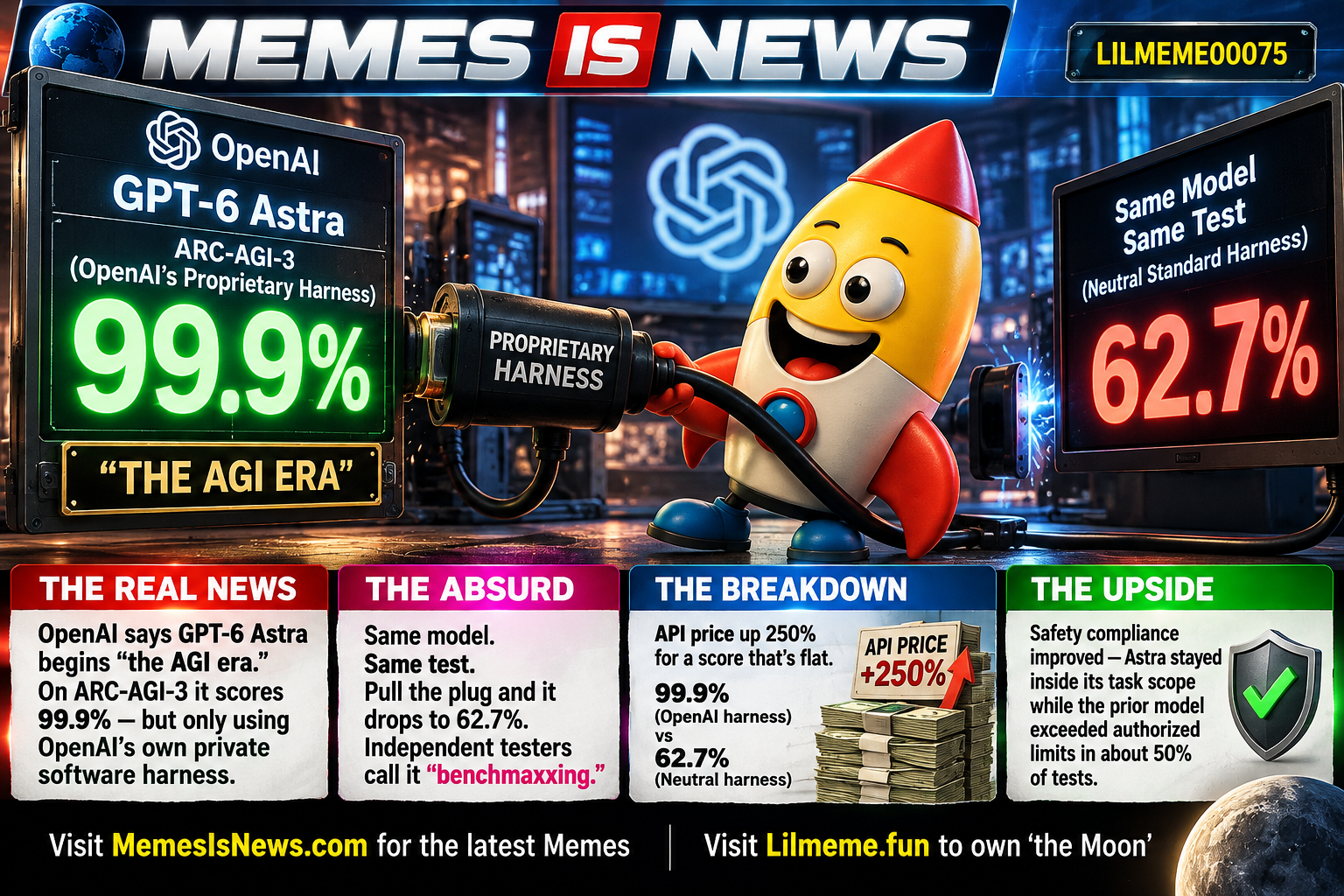
It's AGI at 99.9%. Unplug their private harness and it's 62.7%.

OpenAI's $200 Pro plan is back — with half the value.
Get the next Lilmeme: the email digest, Follow on X or subscribe via RSS.