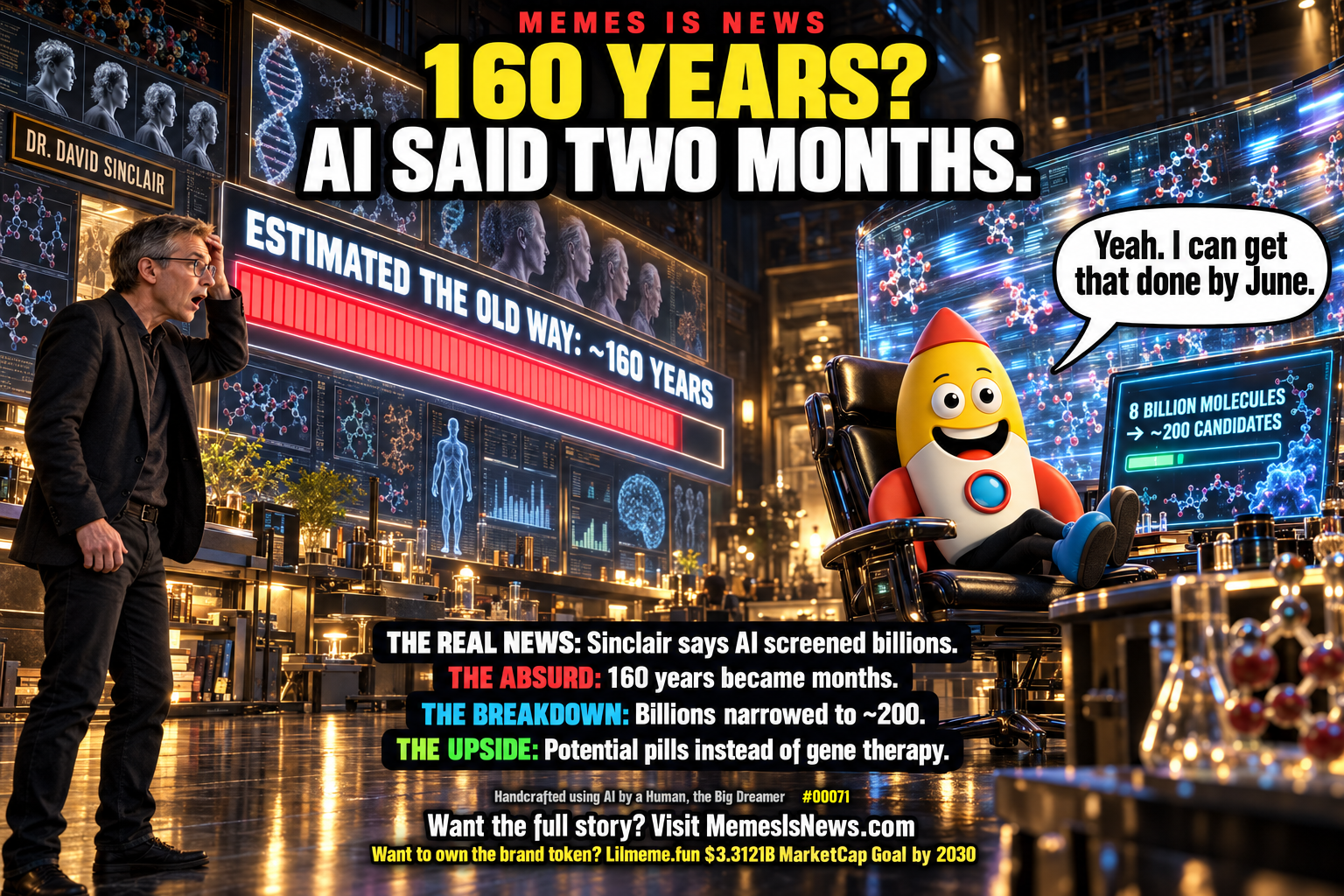
160 years? AI said two months.
THE REAL NEWS: Harvard longevity scientist Dr. David Sinclair says his lab used AI to screen 8 billion virtual chemicals for aging drugs. THE ABSURD: What he estimates would have ...
Read the original caption
THE REAL NEWS: Harvard longevity scientist Dr. David Sinclair says his lab used AI to screen 8 billion virtual chemicals for aging drugs. THE ABSURD: What he estimates would have taken his lab ~160 years, the AI did in about two months. THE BREAKDOWN: Billions of virtual molecules narrowed to roughly 200 real candidates that can be tested in human cells. THE UPSIDE: If it works, longevity medicine could arrive as pills instead of gene therapy. Source: AI World Today interview, 8 Aug 2026 (Sinclair on the Joe Rogan Experience). More memes: MemesIsNews.com. Own 'the Moon': Lilmeme.fun.
The real news
The story, straight
Harvard longevity scientist Dr. David Sinclair says his lab used AI to screen 8 billion virtual chemicals for aging drugs. His estimate for the same work by hand: about 160 years.
The AI did it in roughly two months, narrowing the field to about 200 real candidates that can be tested in human cells.
The absurd
Why this is ridiculous
160 years of lab bench compressed into a two-month afternoon. The punchline is Sinclair's own number: one year, one month, one day, if the humans did it.
The clock didn't just tick - it became the joke.
The breakdown
How it breaks down
The trick is the funnel. Eight billion chemicals can't be tested, so a model scores them virtually and hands back about 200 real ones - and only those 200 ever see a lab.
The cost of a 'no' becomes a computation instead of a reagent. Screening stopped being a lab problem the moment it became a math problem.
The upside
Why it could matter
If it holds, longevity medicine arrives as a pill instead of a gene therapy - the form most of the world can actually take. The deeper lesson is the one every field will feel: the bottleneck of discovery was never knowledge or chemistry.
It was the sheer time it takes to check. Slow 'checking' is the new scarce resource.
Sources
One more Lilmeme?
Surprise me →
ANCIENT CHINA DROPPED A BURNOUT ANTHEM

AI GAVE THE CABINET GANGNAM FEVER.

META JUST TOOK ITS AI TAB TO WALL STREET.
Get the next Lilmeme: the email digest, Follow on X or subscribe via RSS.