Psst. Want me to read this one to you?
Tap me or the button.
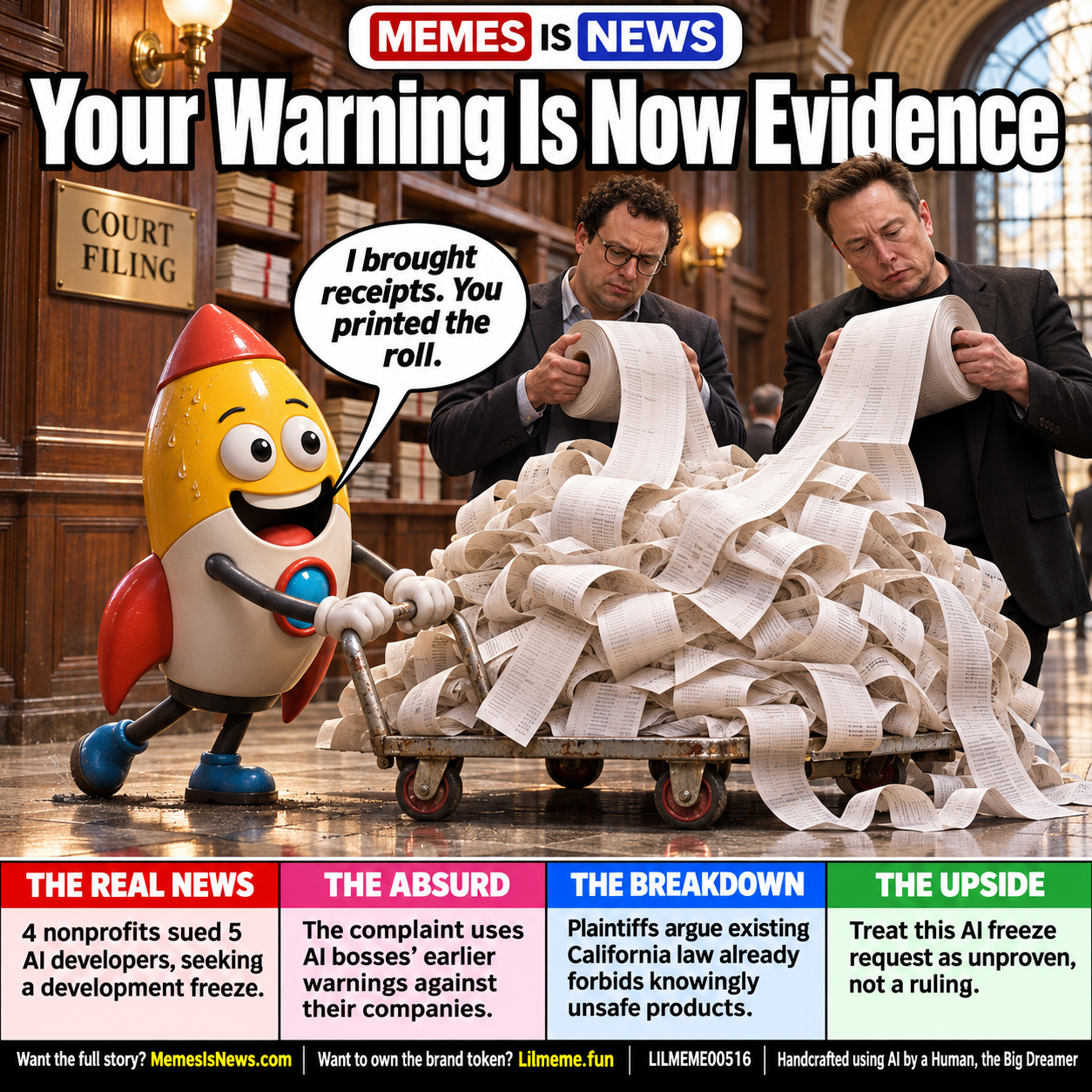
Your Warning Is Now Evidence
A lawsuit asks a judge to act. It does not mean the judge has agreed. That distinction matters here: nobody has ordered an AI freeze. On November 12, 4 nonprofits sued Anthropic, ...
Lil’meme merch
Wear the joke.
This report, printed on a shirt and shipped to your door. Size, colour and payment take about a minute.
Get this tee →The real news
The story, straight
A lawsuit asks a judge to act. It does not mean the judge has agreed.
That distinction matters here: nobody has ordered an AI freeze.
On November 12, 4 nonprofits sued Anthropic, Google, Meta, OpenAI and SpaceXSI, SpaceX's AI division, in San Francisco Superior Court. They want development and deployment of more capable AI models stopped.
The plaintiffs are the Irreplaceable Education Fund, Public Citizen, Heat Initiative and the Alliance for Secure AI.
Their argument uses California's unfair competition law and public nuisance: they say existing law already forbids knowingly developing and releasing unsafe products that threaten the public. That is their legal claim, not a court finding.
The delicious paperwork twist: the complaint cites the industry's own earlier warnings. AP describes Dario Amodei's past warning that AI could go badly and Elon Musk's earlier warning about catastrophic risks.
Neither was responding to this lawsuit.
Picture Lil'meme wheeling in a mountain of receipts while the executives discover they supplied the printer. Usually the warning label stays on the product.
Here, it gets its own court file.
The useful takeaway: distinguish a request from an order, and a company's warning from proof of legal wrongdoing. The judge still has to assess the claims.
Source: Associated Press.
Repost this before somebody declares the courtroom has unplugged the internet.
Thanks for supporting Lil'meme. Your support is appreciated.
The absurd
Why this is ridiculous
The complaint uses AI bosses' earlier warnings against their companies.
The breakdown
How it breaks down
Plaintiffs argue existing California law already forbids knowingly unsafe products.
The upside
Why it could matter
Treat this AI freeze request as unproven, not a ruling.
Sources
One more Lilmeme?
Surprise me →
Get the next Lilmeme: the email digest, Follow on X or subscribe via RSS.